9/28/2025 The Squid and Flying Bat Nebulae

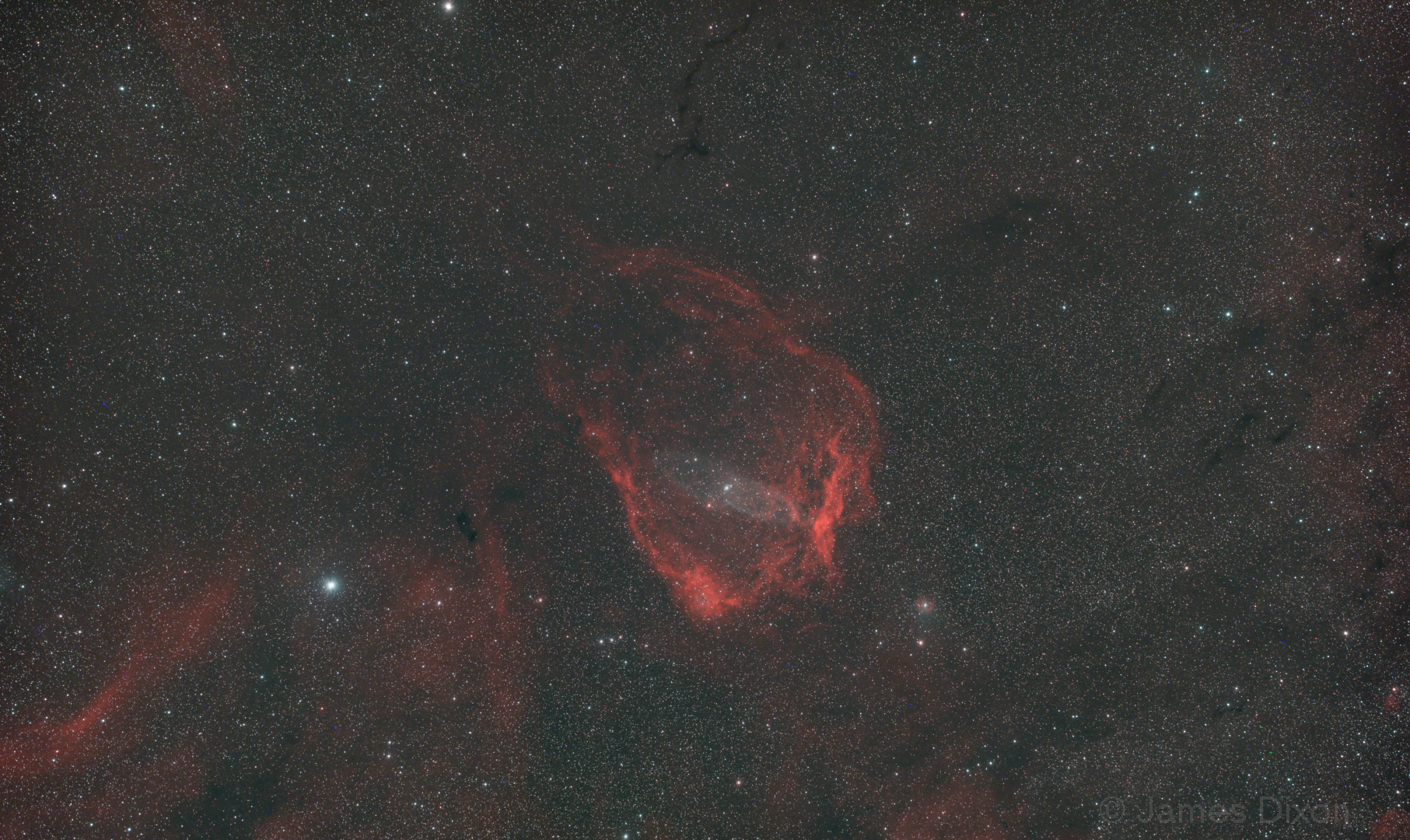
Three months and a week ago, I started this astrophotography project, my longest to date. The big red bell shape in the middle is SH2-129, the Flying Bat Nebula. Just 11 years ago, in 2011, a patient and dedicated amateur astronomer named Nicolas Outters discovered something odd, a green semi-oval shaped nebula inside or in front of it. The squid is dim. After four hours of integration, I thought I could see it there. After eight, I was sure. But people said it needed at least 20 hours. This weekend, I was able to add another 16 hours on it with my Samyang 135mm and ASI2600MC Pro camera and an L-Extreme F2 dual narrowband filter. This is a total of 296 five minute integrations. or 24.66 hours. Click it for a closeup.

The red Flying Bat is glowing in Hydrogen Alpha light while the Squid is glowing in Oxygen III light, between them those are the two most prominent types of emission nebula. Here is someone else’s close up of the squid so that you can see how it got that name. https://commons.wikimedia.org/wiki/File:Flying_Bat_and_Squid_nebulae_narrowfield.jpg

I may try this again next year with my 11″ SCT, it has a focal length times the Samyang 135.

9/1/2025 Pickering’s Triangle

Here is Pickering’s Triangle, the middle part of the Veil Nebula aka the Cygnus Loop. Regardless of what you call it, this is part of a supernova remnant in the constellation of Cygnus. The entire loop is about 3 degrees or six moon widths across. This was shot on August 22nd with my 11″ SCT at f/1.9 with an Antlia Triband RGB Ultra file and ASI2600MC Pro camera.

8/31/2025 Work In Progress

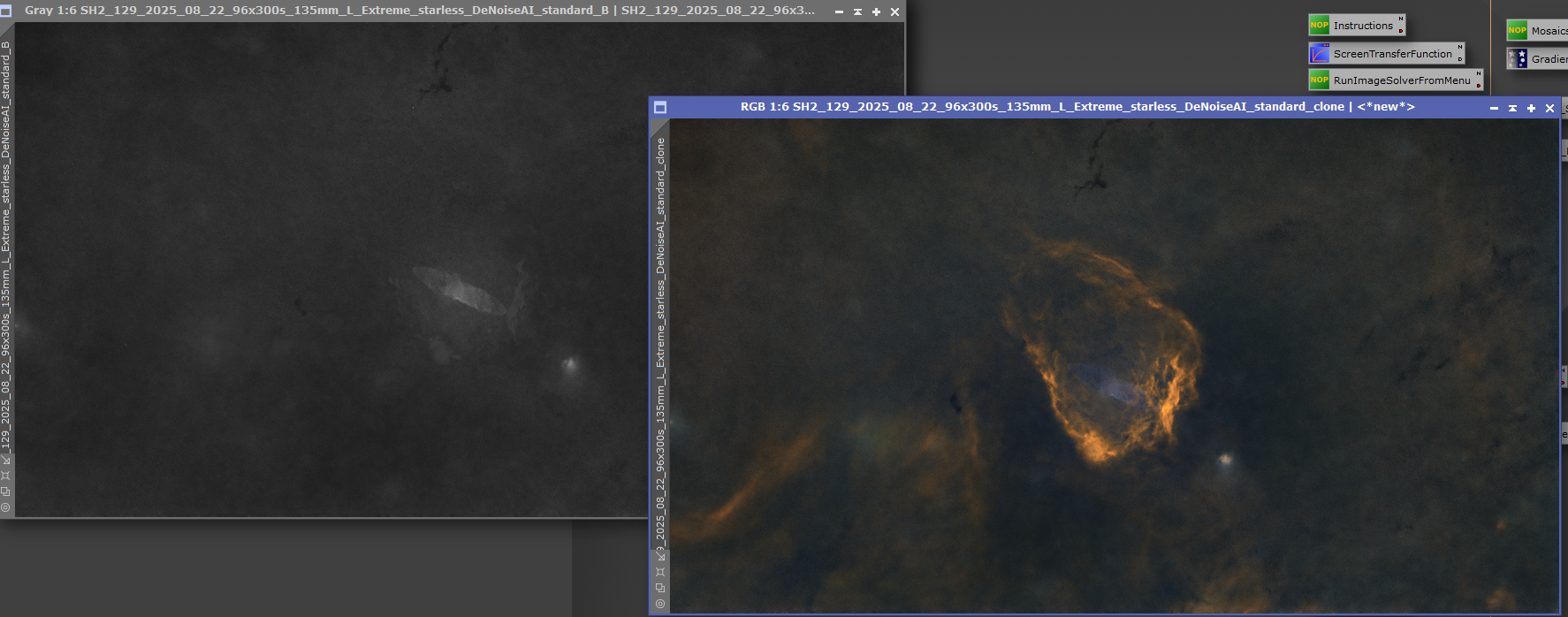
I’ve been working on the “Squid Nebula” (aka OU4) in Cepheus. It is the smaller elongated blue object above and lies in front of the much brighter “Flying Bat Nebula” (aka SH2-129). The flying bat looks a lot more like a bell than a bat to me but the squid looks like a squid. The Flying Bat Nebula is a Hydrogen Alpha (Ha) emission nebula, glowing reddish from energized hydrogen. The Squid Nebula is an Oxygen III (Oiii) emission nebula energized by a triple star system at it’s core.

The Squid is so faint it was only discovered in 2011. I’ve read in several places you need to have at least 20 hours of exposure to do it justice. After 4 hours taken in June, I felt confident I could see something there. After 4 more taken in August, for a total of 8 hours so far, I have enough for it to start taking shape. That is what you see above.

The image above is just a screen snippet of 8 hours of exposure with a Samyang 135mm lens, Optolong L-Extreme F2 filter (which lets through only Ha and Oiii), and ZWO ASI2600MC Pro camera. I extracted the blue channel, processing is separately and then combined it back with the other two channels.

This object will be in the evening sky for a few months, which is good as it has been cloudy a lot. This is undoubtedly the dimmest object I’ve attempted taking the crown from the Spaghetti Nebula (https://jamesdixon.us/12-20-2024-the-spaghetti-nebula/) I shot last winter and plan to shoot again this winter.

LinkedIn
LinkedIn
Share