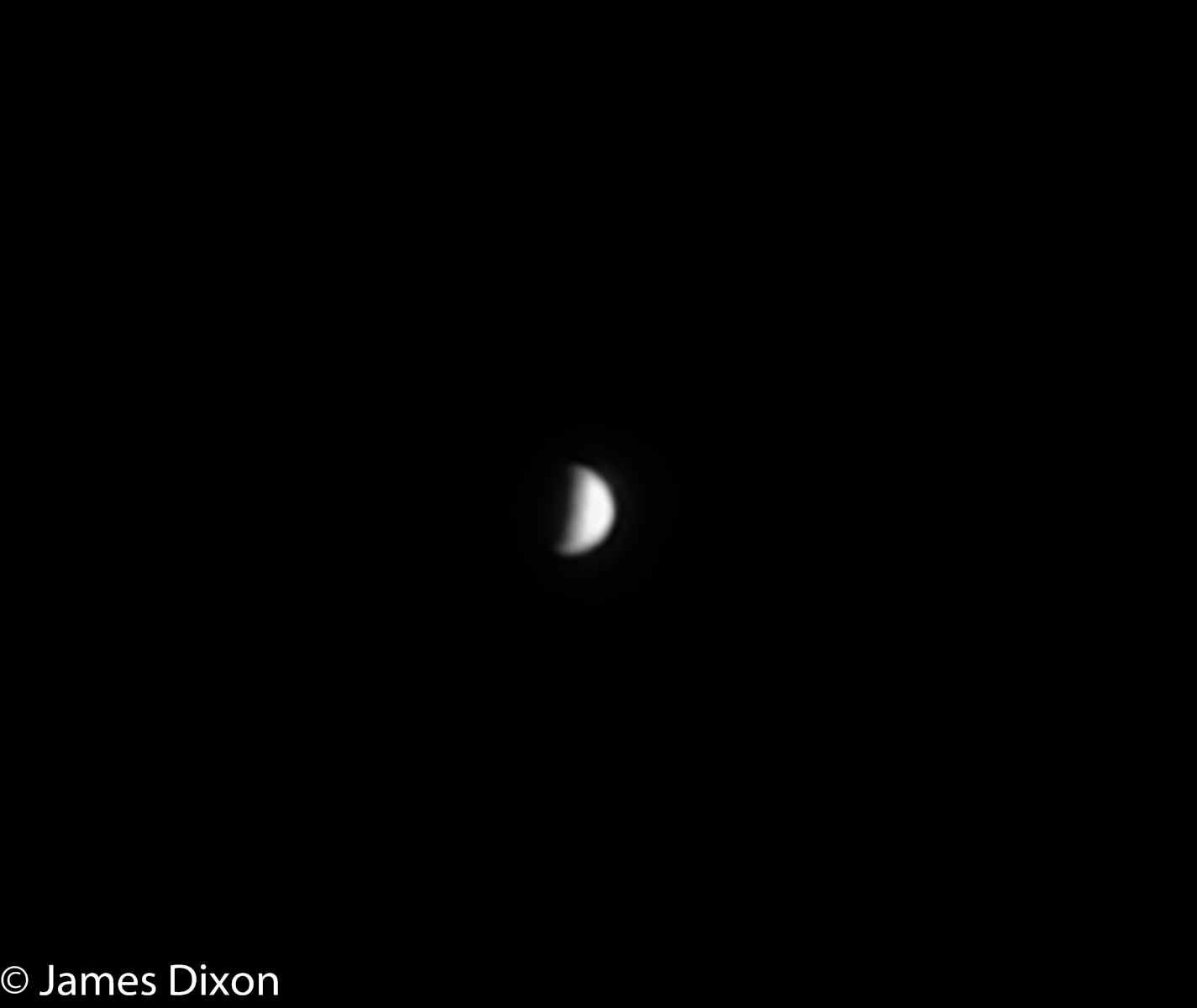
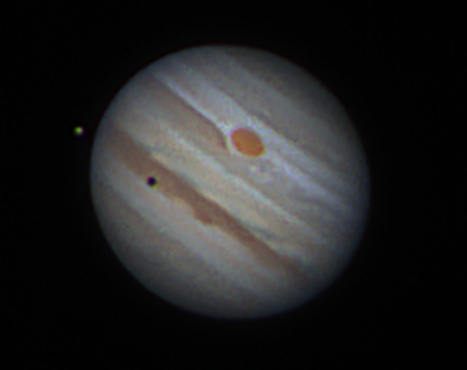
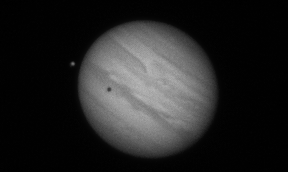
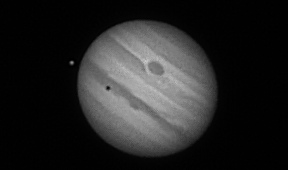
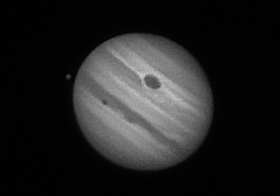
Friday night I went up to the River Ridge Observatory to shoot some planets. I started with Venus which is about as high in the sky after sunset as it will get in this apparition. It was disappointing so I moved on. Next up was Jupiter. I’m using a monochrome camera with RGB filters so here we have the combined result with the red, green and blue images that went into it. The color image is softer than I’d like but shows Io and it’s shadow that were transiting the disk of Jupiter this evening, They were both near the meridian of Jupiter when I started and visible on the laptop. Below are the red, green, and blue filter monochrome images that went into the image above. Notice the red spot is barely visible in the first image which is the red channel and darkest in the last image which is the blue channel.
Barnard’s Star 2016-2018
Here is a short (2 frame) video of a nearby star called “Barnard’s Star” in the constellation of Ophiuchus. After the famous Alpha Centauri triple star system, this is the closest star to the Solar System at 6 light years away. By a weird coincidence, just over one hundred years ago an astronomer named E.E. Barnard discovered that this star is moving across the sky faster than any other object in the sky beyond the Solar System. This “proper motion” is measured at 10 arcseconds per year. By comparison, the planet Jupiter appears to be about 40 arcseconds across from Earth. Not a lot but easily measurable with a telescope and camera. In these two images, take 26 months apart, we can see one star move to the left just a little.
Mercury March 14, 2018
Here is an image of Mercury taken from the River Ridge Observatory this evening. Mercury is currently popping up in the western sky for a few days as it does about four times per year before it slides right back down toward the Sun. Right now it is above and to the right of Venus but dimmer. Over the next several days it will get larger and more crescent shaped but will also get closer to the Sun making it more difficult. This was taken with my trusty 9.25″ SCT with my ASI120MM camera. A red filter was used to reduced atmosphere induced chromatic aberration. I combined the best 25% of 5000 1 millisecond images then sharpened in Photoshop.