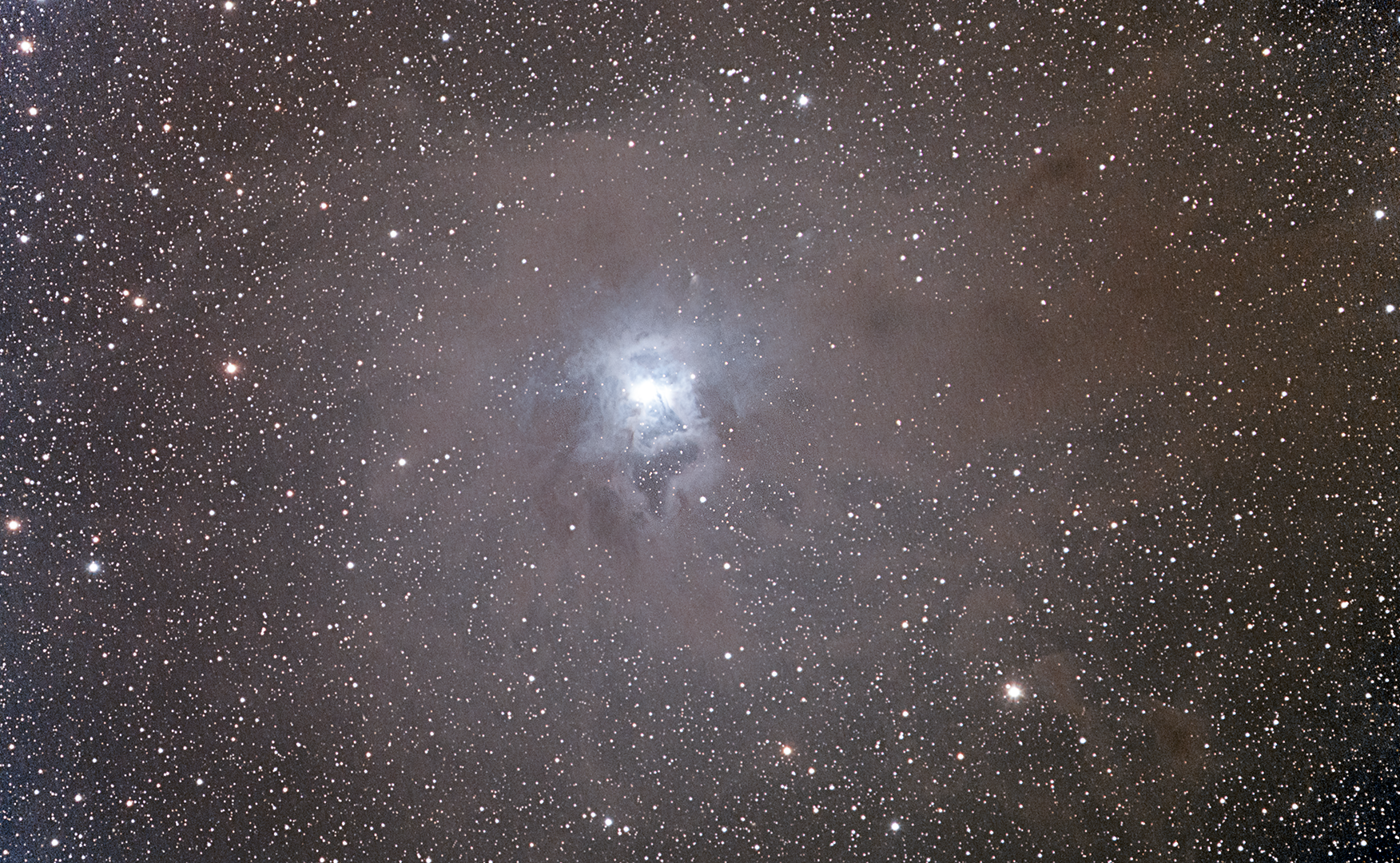
NGC 6820 is a small reflection nebula near the open cluster NGC 6823 in Vulpecula. The reflection nebula and cluster are embedded in a large faint emission nebula called Sh 2-86. The whole area of nebulosity is often referred to as NGC 6820. This was made from 30 2 minute images combined taken with my ZWO ASI294MC Pro and 11″ SCT with the Hyperstar adapter.
Angie and I took Arkansas 7 up to Harrison for fall foliage today. Despite a forecast saying that this is the peak, today was too early. That said we did see some color and here at Maplewood Cemetery I got a few shots. There were already plenty of leaves on the ground so there might be a short period between peak foliage and bare trees.
Tuesday evening, I went to the River Ridge Observatory and set up my C11 with Hyperstar and ZWO ASI294MC Pro camera with the dual narrowband Optolong L-eNhance filter in place. The image below is about 35 two minute images stacked and combined with flats and darks applied. All subsequent processing was done in Adobe Photoshop and Adobe Camera Raw.
NGC 7635, also known as the Bubble Nebula, Sharpless 162, or Caldwell 11, is an H II region emission nebula in the constellation Cassiopeia. It lies close to the direction of the open cluster Messier 52. The “bubble” is created by the stellar wind from a massive hot, 8.7 magnitude young central star, SAO 20575 (BD+60°2522). The nebula is near a giant molecular cloud which contains the expansion of the bubble nebula while itself being excited by the hot central star, causing it to glow. It was discovered in 1787 by William Herschel. The star BD+60°2522 is thought to have a mass of about 44 solar masses. Messier 52 or M52, also known as NGC 7654, is an open cluster of stars in the northern constellation of Cassiopeia. It was discovered by Charles Messier on September 7, 1774. M52 can be seen from Earth with binoculars. The brightness of the cluster is influenced by extinction, which is stronger in the southern half.