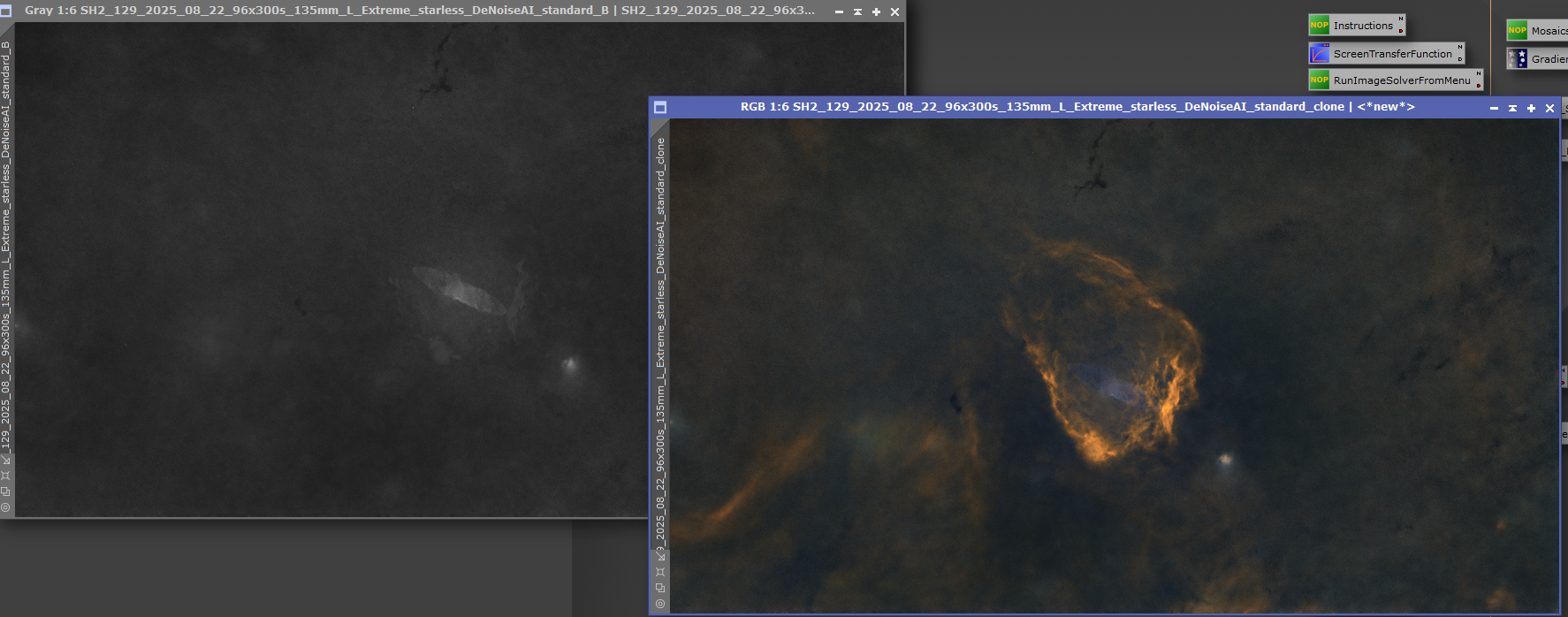
I’ve been working on the “Squid Nebula” (aka OU4) in Cepheus. It is the smaller elongated blue object above and lies in front of the much brighter “Flying Bat Nebula” (aka SH2-129). The flying bat looks a lot more like a bell than a bat to me but the squid looks like a squid. The Flying Bat Nebula is a Hydrogen Alpha (Ha) emission nebula, glowing reddish from energized hydrogen. The Squid Nebula is an Oxygen III (Oiii) emission nebula energized by a triple star system at it’s core.
The Squid is so faint it was only discovered in 2011. I’ve read in several places you need to have at least 20 hours of exposure to do it justice. After 4 hours taken in June, I felt confident I could see something there. After 4 more taken in August, for a total of 8 hours so far, I have enough for it to start taking shape. That is what you see above.
The image above is just a screen snippet of 8 hours of exposure with a Samyang 135mm lens, Optolong L-Extreme F2 filter (which lets through only Ha and Oiii), and ZWO ASI2600MC Pro camera. I extracted the blue channel, processing is separately and then combined it back with the other two channels.
This object will be in the evening sky for a few months, which is good as it has been cloudy a lot. This is undoubtedly the dimmest object I’ve attempted taking the crown from the Spaghetti Nebula (https://jamesdixon.us/12-20-2024-the-spaghetti-nebula/) I shot last winter and plan to shoot again this winter.